
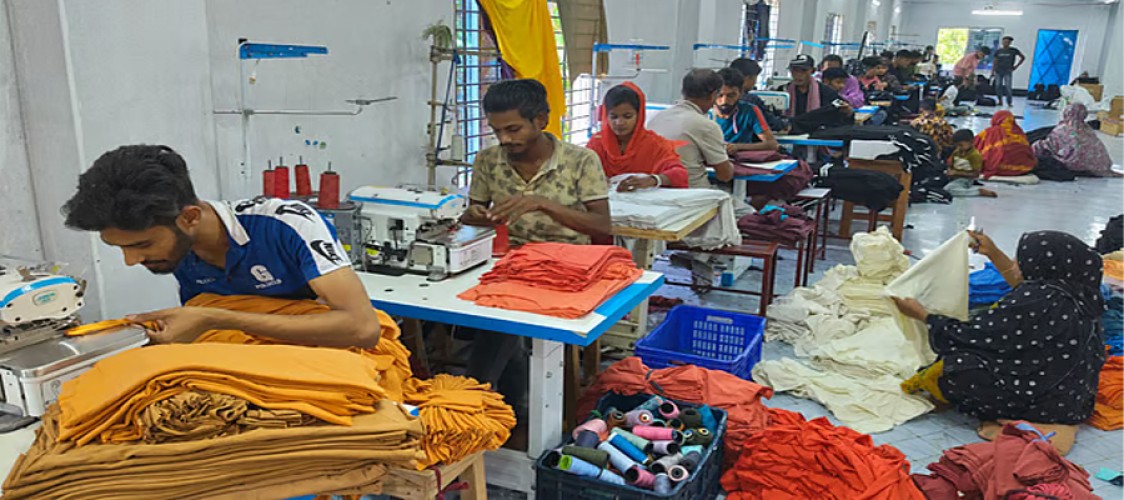
Many factories have been set up in the villages of Pabna district to make jhum cloth. However, due to the closure of the land port in India, traders are facing difficulties in exporting these jhum cloth. Recently, in the Jhutpatti area of Sadhupara, Pabna. Photo: Collected
Arif Hossain, a hosiery trader from Sadhupara Mohalla in Pabna city, had taken a loan from the bank to set up a large hosiery factory. About 400 people were employed there. He was also earning a good income by exporting products. But after the export of products from Bangladesh to India by land route was stopped, he was in trouble. Unable to sell the products, he was forced to close the factory. He went bankrupt due to debts. 400 workers became unemployed.
Like Arif Hossain, numerous hosiery entrepreneurs in Pabna are facing the same crisis. According to the District Hosiery Manufacturers Group, more than a million workers used to work in about 3,000 hosiery factories in the district. About 65 percent of the workers are now unemployed due to the ban on exports. Factories are closing down one after another due to the crisis.
District Hosiery Manufacturers Group President Selim Sardar told Prothom Alo that 65 percent of the country's hosiery products were exported from Pabna. Every day, there are disputes between creditors and owners. Overall, the situation is getting very bad. This situation needs to change quickly to save the industry and protect the owners and workers.
200 years of ups and downs
Talking to senior hosiery traders, it was learned that this industry was founded in Pabna about 200 years ago. At that time, goods were imported and exported through the Ichamati river that flows through the middle of the city. The wealthy Hindu and Marwari traders of that time imported high-quality yarn from abroad and produced jerseys using their own yarn. That high-quality jersey quickly became known at home and abroad.
After the partition of the country in 1947, most of those traders moved to India. After that, the industry declined. After that, control of the industry gradually came into the hands of Muslim traders. They tried to sustain the industry, but after independence, the industry almost collapsed in 1972. After going through various ups and downs, in 1990, instead of yarn shirts, ready-made garment factories started producing various products including jhum cloth shirts, shirts, pants, sweaters. As a result, the scope of the industry continued to grow. These products started to be exported to various countries in the Middle East, including India and Malaysia.
Crisis after the closure of land exports
Factory owners said that earlier hosiery products were exported to India by truck. Every week, more than a hundred trucks of products used to go to India. This would bring in 150,000 to 200,000 US dollars. After the closure of the land route, now only seven to eight trucks of products are being sent by sea per week. On the one hand, the cost of sending products through Chittagong Port is increasing, on the other hand, it also takes more time. Again, it takes more than a month to get the price of the products. All in all, entrepreneurs are suffering losses.
Mirajul Islam, a hosiery trader from Dwipchar in Pabna suburb, used to buy jhut cloth from Dhaka and Narayanganj and make various garments including shirts, sweaters, socks and other items and export them to various countries including India, Malaysia and Qatar. He said that two-thirds of their products were exported to India. Products worth about Tk 2.5 million were exported every week. More than a hundred workers were employed. After the export was stopped, there is no income now. They are worried about bank loans.
Md. Ashiq Hossain, manager of SB Royal Garments in Sadhupara Mohalla, said, "Our backs are against the wall due to the stoppage of exports by land. Earlier, there was no time to catch our breath due to the pressure of work. About 30 workers used to do only cutting work. Now there are seven. As a result, we spend our days lying down.’
A day in the land
Recently, I visited various areas of the city, including Sadhupara, Banglabazar, and Dilalpur, and saw that large jhut cloth-based factories have been set up in the city and in the neighborhoods of the village as well. Some are cutting clothes, some are sewing. However, during the conversation, I noticed a look of concern on most of their faces. The warehouses and showrooms of the factories have stocks of manufactured products. Jhut cloth is also lying in sacks. Most of the factories do not have more than half of the workers. Those who are there are not as busy as before.
Sadhupara jhutpalli businessman Rabiul Islam said that he buys and sells jhut cloth from ready-made garment factories in various industrial areas including Dhaka, Chittagong, and Gazipur. Earlier, he could not even finish with the cloth. But there has been no sales for one and a half years. He is sitting with a warehouse full of clothes. Earlier, there were 15 workers in the selection of clothes. Due to lack of work, 10 people had to be laid off.
Another businessman from the same area, Faruk Hossain, said that some of them do business with loans from banks and some from NGOs. Business was going better in foreign markets than in the country. Everyone is in a big crisis as trade with India has stopped by land.
Many have lost their jobs
A worker named Afzal Hossain said that he lost his job at a factory in Sadhupara Mohalla and is now looking for another job.
Johnny Garments manager Kamrul Hasan said that it used to take two to three days to export goods by land. Money would be available within five days. Now it takes 20 to 25 days to send goods by sea. Money comes after 30 to 35 days. As a result, a small amount of goods is being sent to sustain the business. Some of their factories used to employ about 500 workers, which has now reduced to 200.
Tarun Das, the district's largest hosiery seller, prints various designs on products produced at AR Corner. He said that there is almost no work due to the stoppage of exports. He is spending his days unemployed. His wife is sick. He is unable to raise medical expenses. It has become difficult to manage a family with two children and a wife.
Pabna Chamber of Commerce and Industries Director ABM Fazlur Rahman said, "The hosiery industry is the heritage of Pabna. The district's identity was created through this industry. The industry had great potential. But now it is in extreme crisis. The government's goodwill is needed to overcome this crisis. Initiatives must be taken to quickly open the land route for import and export to protect the industry. He expressed hope that the current government will take quick initiatives considering the matter."
Source: Online/GTexpo
































Copyright © 2026 LIMRA Exhibitions. All Rights Reserved.
Website Design & Development ♡ MY SOFT IT
 EN
EN
 Chinese
 Turkish
 Indonesian
 German
 French
 Spanish
 Portuguese
 Russian
 Italian
